
Scaling Design Systems with Figma and Mendix
How we architected a single-source-of-truth token pipeline across 20+ enterprise applications, aligning Figma Variables with Mendix low-code components to slash handoff friction by 68%.
On This Page
1. The Enterprise Bottleneck: Why Most Design Systems Stall
In mid-to-large enterprise environments, design systems often start with tremendous enthusiasm. Teams build gorgeous Figma libraries with hundreds of components. But within 12 months, the system begins to fracture. Developers fork components, inline custom CSS overrides creep into production, and designers complain that their polished mockups look completely distorted when shipped.
The fundamental flaw is rarely component aesthetics; it is architectural disconnect. When a design system is treated merely as a "Figma sticker sheet" rather than a programmatic contract between design tokens, low-code platforms (like Mendix), and production code, divergence is guaranteed.
2. The Three-Tier Token Model: From Primitive to Component
To enable seamless multi-theme support (Dark/Light mode, high-contrast accessibility, and multi-brand enterprise subsidiaries), we implemented a strict 3-tier token hierarchy:
- Global Primitives: Raw values (e.g.,
color-zinc-950: #09090b,space-4: 16px). These never get directly consumed in UI components. - Semantic Tokens: Intent-based aliases (e.g.,
surface-primary,border-interactive-hover,text-muted). These dynamically swap based on the active theme mode. - Component-Scoped Tokens: Isolated parameters (e.g.,
btn-primary-bg,table-header-height). These prevent cascading side-effects across unrelated widgets.
{
  "semantic": {
    "surface": {
      "canvas": { "$value": "{primitive.zinc.950}", "$type": "color" },
      "panel": { "$value": "{primitive.zinc.900}", "$type": "color" },
      "card": { "$value": "#121215", "$type": "color" }
    },
    "border": {
      "subtle": { "$value": "{primitive.zinc.800}", "$type": "color" },
      "focus": { "$value": "#ffffff", "$type": "color" }
    }
  }
}
3. Bridging Figma Variables to Low-Code (Mendix & React)
In large enterprise ecosystems, many mission-critical workflows are delivered via low-code platforms (such as Mendix/React) for rapid business enablement. Historically, these platforms suffered from rigid, generic UI kits.
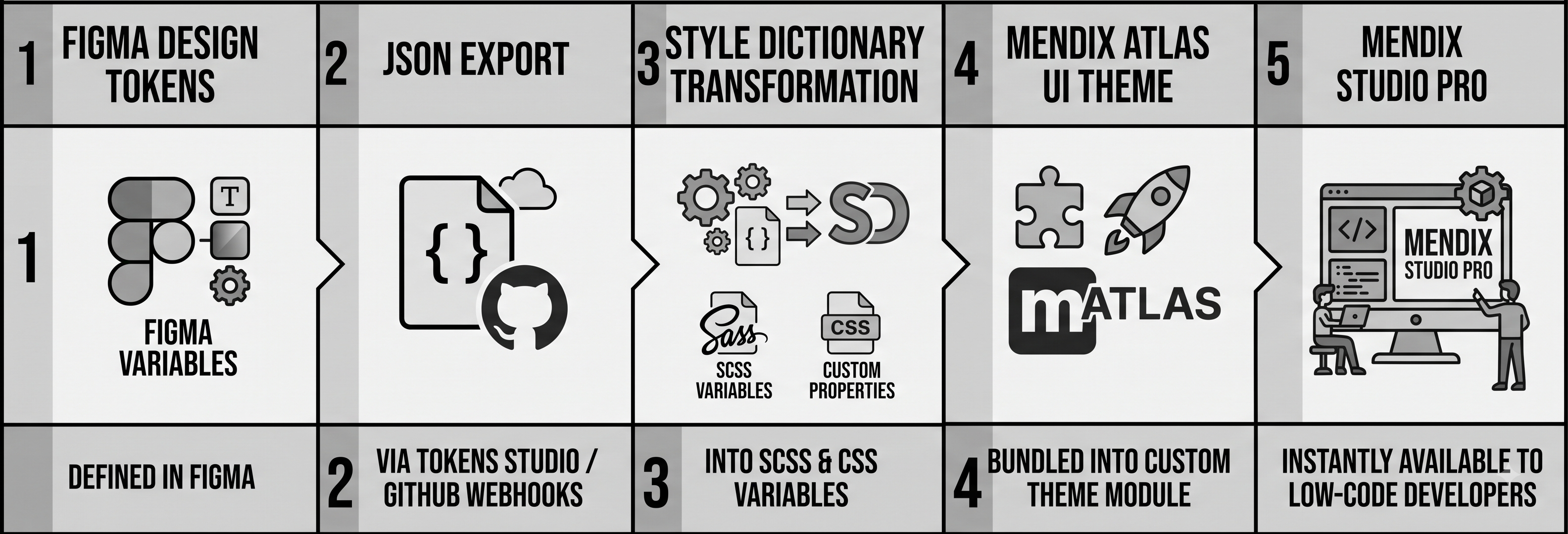
We solved this by establishing an automated export pipeline:
- Design tokens defined in Figma Variables are exported as JSON via Tokens Studio / GitHub Webhooks.
- Style Dictionary transforms the JSON into SCSS variables and CSS Custom Properties.
- The compiled CSS is bundled into the custom Mendix Atlas UI Theme Module, instantly available to low-code developers in Mendix Studio Pro.
"When enterprise low-code engineers can drag-and-drop pre-tokenized widgets without touching custom CSS, UI consistency becomes the path of least resistance."
4. Component Governance Without Bureaucracy
To prevent component sprawl while supporting fast-paced product squads, we introduced a 3-Stage Lifecycle Model:
- Experimental (Squad Level): Designers and engineers can prototype custom UI patterns directly in their project branch.
- Candidate (System Review): If a pattern is needed across 2 or more applications, it undergoes accessibility (WCAG AA), token audit, and keyboard navigation testing.
- Core (Production System): Published into the global package with semantic versioning (
v2.4.0) and changelog documentation.
5. Business ROI & Measured Telemetry
Deploying this tokenized architecture across our B2B SaaS and enterprise ecosystem produced clear, quantifiable returns:
- -68% Reduction in Handoff Cycle Time: Front-end sprint velocity increased dramatically since zero time was wasted debating hex codes or padding discrepancies.
- 99.9% Design Consistency: Visual regression tests passed with near-zero deviations across 20+ applications.
- Zero-FOUC Dark/Light Theme Switching: Native CSS custom properties allowed instantaneous theme toggles without layout reflow.

Written by Niraj Kumar
Pune, IndiaI design enterprise software and reusable interfaces at Schaeffler India.